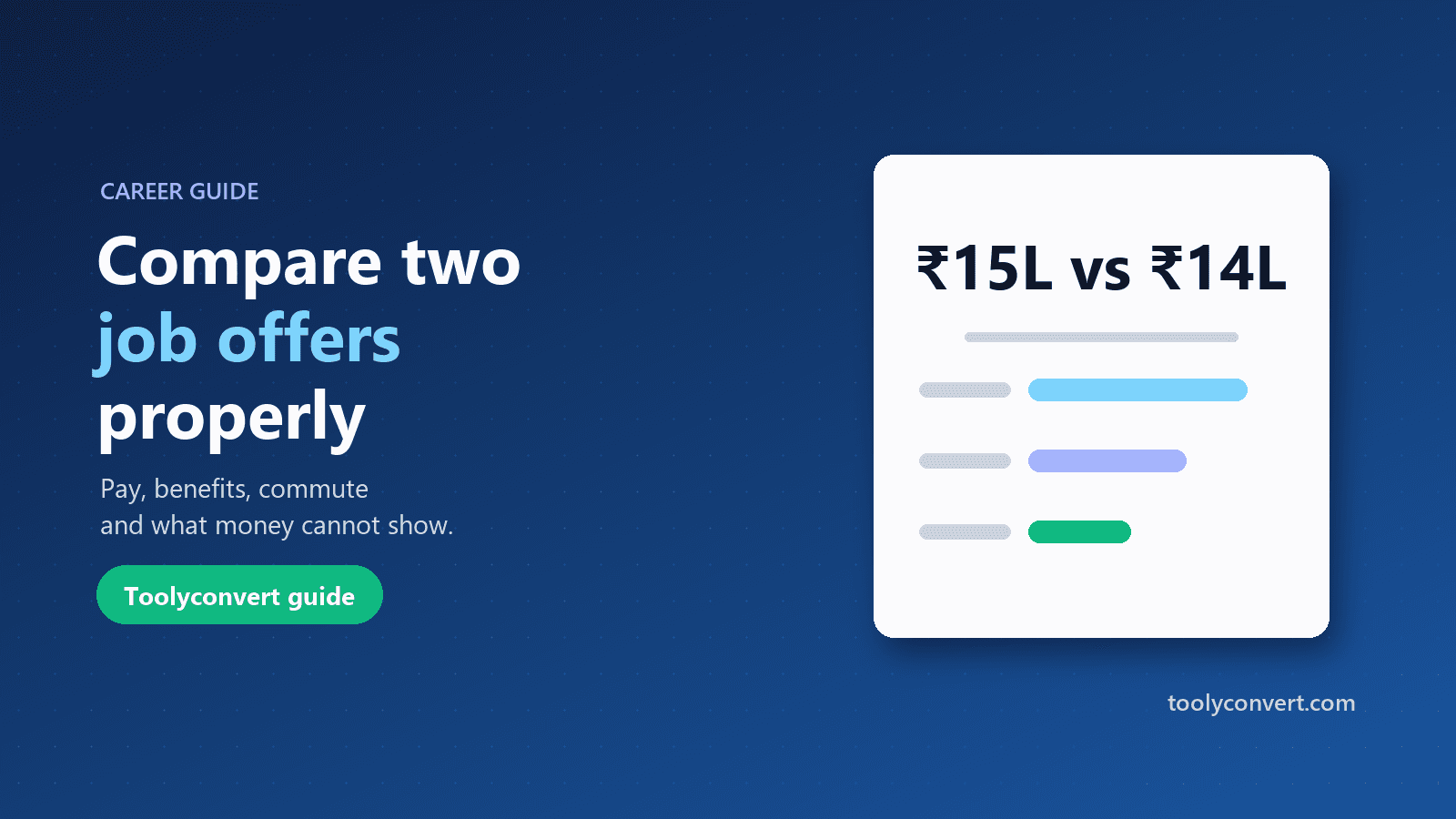
Two offers arrive in the same week. One says ₹15 lakh CTC with a ₹1.5 lakh joining bonus, five days in an office 75 minutes away. The other says ₹14 lakh CTC, fully remote, with a bigger PF contribution and more leave. Which is better? Looking at the headline number, the first. Looking at what you would actually receive, keep, and spend your time on, it is far less clear.
Comparing job offers well means turning each one into numbers you can compare fairly, and then deciding with the things numbers cannot capture. This guide walks through both.
Step 1: Get the full breakdown of each offer
You cannot compare offers from a single figure. Ask each company for the breakdown in writing, ideally in the offer letter:
- Fixed pay: basic salary and allowances paid monthly.
- Variable pay or bonus: the target percentage, how it is decided, and what was actually paid last year.
- Joining or sign-on bonus: the amount and any clawback if you leave within a set period.
- Employer retirement contribution: PF in India, 401(k) match in the US, pension elsewhere.
- Equity: number of ESOPs or RSUs, the vesting schedule, and how they are valued.
- Benefits: health insurance (including family cover), meal cards, learning budgets, internet or equipment allowances.
- Leave: paid leave days and holidays.
- Work location: office days a week and where the office is.
- Terms: notice period, probation, and any bond or non-compete clauses.
Having everything on paper also protects you if anything changes before your joining date.
Step 2: Put every offer on the same yearly basis
The fairest single number is the yearly value you can expect every year:
yearly value = base salary + expected bonus + equity per year + employer retirement contribution + other yearly benefits
Two adjustments make it honest:
- Leave out one-time payments. A joining bonus is real money, but only in year one. Compare it separately as "first-year total".
- Spread equity over its vesting period. A ₹8 lakh grant vesting over four years is worth about ₹2 lakh a year at today's value, and that value may rise or fall.
The Offer Comparison tool does this for two or three offers side by side, in rupees, dollars or other currencies, and shows both the yearly value and the first-year total. If one offer is in a different currency, convert at today's reference rate first; the Currency Converter helps, and our guide on why bank exchange rates differ explains why the money you receive will be a little less.
Step 3: Value bonuses and equity cautiously
Not all parts of a package are equally certain.
Fixed pay is the most certain. Variable pay depends on your performance and the company's results; ask what percentage of the target employees actually received last year. If the answer is "about half", value it at half.
Equity varies enormously. RSUs in a listed company have a market price, though it moves. ESOPs in a startup are options to buy shares at a set price, often only valuable if the company is sold or listed, and they may be worth much more or nothing. A sensible approach is to compare offers with equity at a cautious value, and then ask yourself whether you would still choose the same offer if the equity turned out to be worth nothing.
Step 4: Count your time, not just your money
Commuting is the cost most people underestimate. A 75-minute journey each way, five days a week, adds up to roughly 575 hours a year over 46 working weeks. That is more than 70 eight-hour working days spent travelling, plus the cost of fuel or fares.
The Offer Comparison tool counts it for you: enter office days a week and the one-way commute for each offer, and it shows commuting hours per year and pay per hour including commute time, using 8-hour days and your paid leave and public holidays.
In the example from the start of this guide, the ₹15 lakh office role works out to about ₹621 per hour once commuting is included, while the ₹14 lakh remote role pays about ₹761 per hour. The lower salary buys back nearly 600 hours a year. That does not automatically make it the better offer, but it changes the conversation.
Step 5: Weigh what money cannot show
Once the numbers are clear, the decision usually comes down to things no calculator can measure:
- The role itself: will you learn, grow and do work you are proud of?
- The manager and team: how did the interviews feel? Could you talk to someone who works there?
- Career trajectory: which role leads more naturally to the job you want in three years?
- Stability: the company's funding, revenue and recent history of layoffs.
- Flexibility: remote or hybrid options, working hours and time zone overlap. For roles with teams abroad, check the overlap with the Time Zone Converter.
- Terms: a long notice period, a bond or a strict non-compete can matter more than a small pay gap.
A useful exercise: write down the three things that matter most to you in this move, score each offer from 1 to 5 on them, and only then look at the money. If the money and your priorities point the same way, the decision is easy. If they disagree, you know exactly what you are trading.
Step 6: Negotiate with the comparison
A clear comparison is also a negotiating tool. If you prefer one company but its offer is lower, you can say so specifically:
"I'm excited about this role and would like to make it work. My other offer is worth about ₹1 lakh more a year in fixed pay. Is there room to close that gap?"
Be honest about competing offers, focus on fixed pay first, and consider other levers such as a joining bonus, a notice-period buyout or a salary review after six months. Our guide on answering the salary expectations question covers how to set your target in the first place, and the Salary Calculator works out walk-away, target and opening figures.
Common mistakes when comparing offers
- Comparing CTC with CTC without looking at what is fixed, variable or non-cash.
- Counting the joining bonus as yearly pay.
- Valuing startup equity at face value.
- Ignoring the commute or office days.
- Forgetting notice periods, which affect when you can join and whether a buyout is needed.
- Deciding only on money when the role, team and growth will shape the next few years more.
Frequently asked questions
How is the yearly value calculated?
Base salary, plus bonus (base × bonus percentage), plus equity per year (grant ÷ vesting years), plus employer retirement contribution (base × percentage), plus other yearly benefits. The joining bonus is shown separately in the first-year total.
How is pay per hour worked out?
Yearly value divided by working hours plus commuting hours. Working hours assume 8-hour days, five days a week, minus your paid leave and 10 public holidays.
Are the figures before tax?
Yes. Tax depends on your country, regime and deductions.
Can I compare more than two offers?
Yes, up to three at once, including your current job as one of them.
Is my data saved?
Only in your browser, so your comparison is there when you return.
A good decision starts with a fair comparison. Get every breakdown in writing, put each offer on the same yearly basis, count your hours as well as your rupees, and then choose with your priorities in front of you. Enter your offers in the Offer Comparison tool and see which one is really worth more.