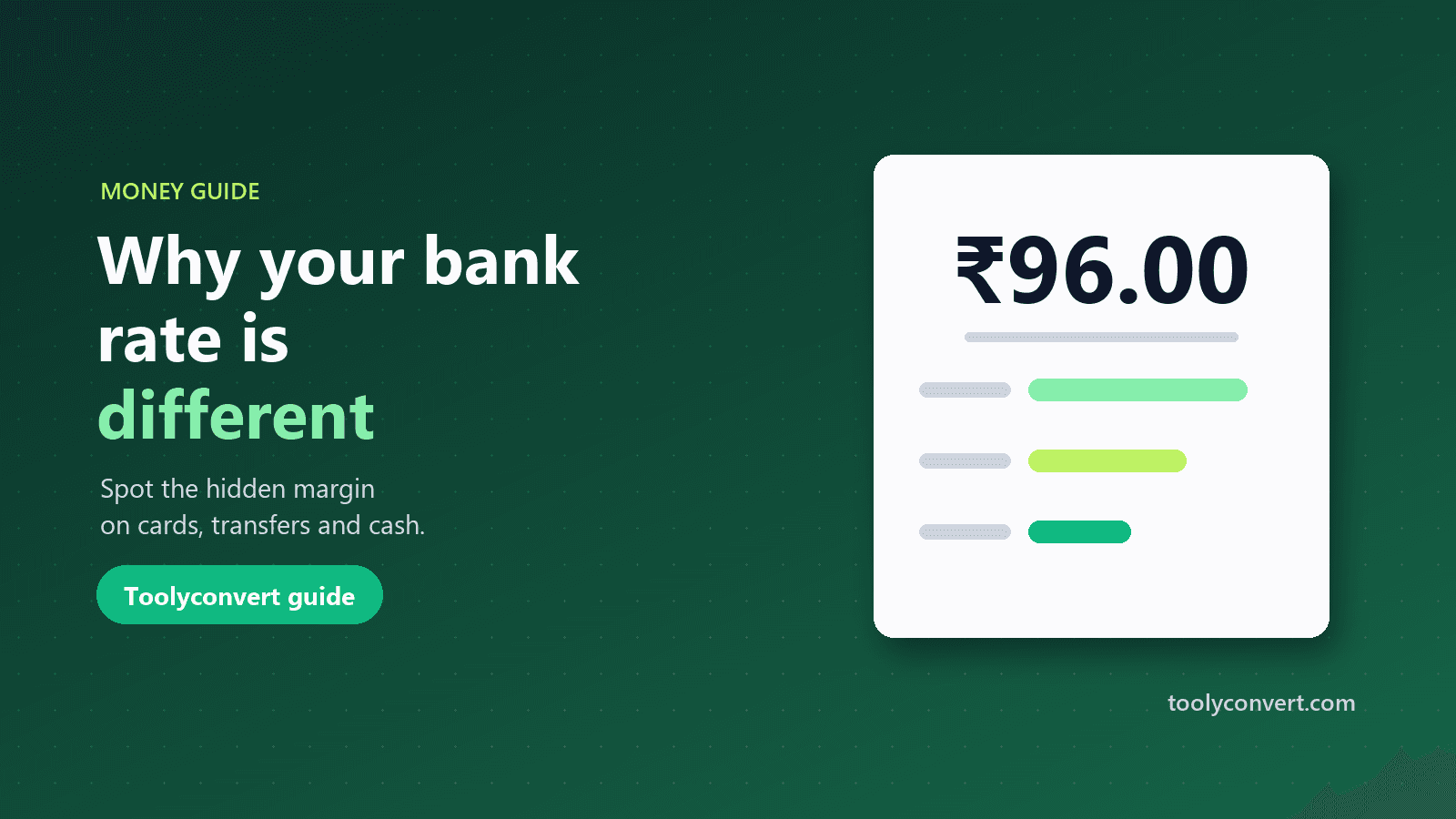
You check the dollar rate before paying for an online course priced at $200. The converter says about ₹96 to the dollar, so you expect to pay around ₹19,200. Your card statement says ₹19,950. Nobody charged you a fee you agreed to, and yet ₹750 disappeared. That gap is the exchange margin, and it is one of the most common hidden costs in everyday money.
This guide explains where the rates you see online come from, why the rate you are offered is worse, and how to work out exactly what you are paying, whether you use a card abroad, send money to family or receive payments from overseas clients.
The mid-market rate: what converters show
Currencies are traded constantly between banks and large institutions. At any moment there is a price buyers will pay and a price sellers will accept; the midpoint between them is the mid-market rate, also called the interbank or reference rate. It is the fairest single number for "what a dollar is worth in rupees right now", and it is what currency converters show.
The Currency Converter uses daily reference rates for more than 160 currencies. They are updated once a day, which is ideal for estimates, budgets and checking what you were charged, though markets move during the day.
Almost nobody outside the banking system can actually trade at the mid-market rate. Everyone else gets a retail rate, which includes the provider's margin.
Where the difference comes from
When you convert money, the provider earns in one or both of two ways:
- An explicit fee, such as a fixed transfer charge or a percentage "forex markup fee" on card transactions.
- A worse exchange rate than the mid-market rate. This is the margin, and it is often the larger cost because it is not labelled as a fee.
A provider advertising "zero fees" can still be expensive if its rate is poor. The only fair comparison is how many rupees (or dollars) you get, or pay, in total, compared with the mid-market amount.
How to calculate the real cost
You need three numbers: the amount, what you actually paid or received, and the mid-market rate on that day.
- Convert the amount at the mid-market rate in the Currency Converter. In our example: $200 × 96 = ₹19,200.
- Note what you actually paid: ₹19,950.
- Work out the difference and the percentage: ₹750 ÷ ₹19,200 = about 3.9 percent.
The Percentage Calculator does the last step instantly. Once you know the percentage, you can compare providers fairly, and it often changes which card or service you choose.
Card payments abroad and on foreign websites
Debit and credit cards usually convert at the card network's rate plus the bank's own markup. Many Indian cards add a foreign currency markup of a few percent to every international transaction, shown on the statement as a separate line or built into the rate. Some cards, often marketed for travel, have a low or zero markup.
A specific trap deserves its own name: dynamic currency conversion (DCC). When paying abroad, a card machine or website may offer to charge you in rupees instead of the local currency. It sounds convenient, but the merchant's provider sets the exchange rate, and it is usually poor. In most cases, choosing to pay in the local currency and letting your own card convert is cheaper. The same applies to cash machines abroad that offer "conversion" to your home currency.
Sending money abroad and receiving it
For transfers, look at the total amount that arrives:
- Banks often charge a fixed fee plus a margin on the rate, and the receiving bank or intermediary banks may deduct more.
- Specialist money-transfer services usually show the rate and fee upfront, and many use rates close to mid-market with a small fee.
- Payment platforms for freelancers convert incoming dollars to rupees with their own margin, sometimes on top of a fee.
Before sending, compare the "recipient gets" figure from two or three services against the mid-market conversion. A difference of even one percent on a large tuition payment or property-related transfer is significant.
Indian residents sending money abroad should also check current rules for the Liberalised Remittance Scheme, including tax collected at source (TCS), which can apply above certain thresholds and for some purposes. The rules change from time to time, so confirm them with your bank before a large transfer.
Cash and forex cards for travel
Buying cash at an airport counter is usually the most expensive way to get foreign currency, because airport outlets combine wide margins with captive customers. Exchanging a small amount for arrival and using a low-markup card or a prepaid forex card for the rest is generally cheaper. Prepaid forex cards lock in a rate when you load them, which helps budgeting, but compare their loading rate with the mid-market rate just as you would any other provider.
When you are abroad, check prices quickly in rupees with the converter's quick-amounts table, which shows 1, 10, 100, 1,000 and 10,000 units at a glance.
Freelancers and remote workers
If you invoice clients abroad, exchange costs come straight out of your income.
- Know what your invoice is worth today. Convert the invoice amount at the reference rate when you send it.
- Compare the amount you receive with that figure to see your platform's or bank's real cost.
- Factor the cost into your rates. A three percent conversion loss on all your income is like a three percent pay cut.
When comparing a foreign job offer with an Indian one, convert both to the same currency and the same yearly basis. Our guide on comparing two job offers explains how, and the Offer Comparison tool handles bonuses, equity and benefits. For salary planning in rupees, the Salary Calculator shows figures in LPA.
A quick checklist before you convert
- Check the mid-market rate for today.
- Ask for the total: how many rupees you pay, or how much arrives, after all fees.
- Work out the percentage difference from mid-market.
- Pay abroad in the local currency, not your home currency.
- Avoid airport exchange counters except for small amounts.
- For large transfers, compare at least two services and confirm any regulatory charges with your bank.
Frequently asked questions
Why is the converter's rate different from Google's?
Different sources update at different times and use slightly different reference prices. Small differences are normal; large ones usually mean you are looking at a retail rate.
Are these live trading rates?
No. They are daily reference rates, which are right for estimates and checks but not for trading.
Why does my bank's rate differ from the converter?
Banks add a margin and fees to the reference rate. The gap is what the conversion costs you.
Is it cheaper to pay in rupees when abroad?
Usually not. Choosing rupees on a foreign card machine triggers dynamic currency conversion, which often has a poor rate.
Does the converter work offline?
Yes, with the last rates saved in your browser, clearly marked as such.
The rate you see online is a benchmark, not a price. Use it to measure what each bank, card and service really charges, and the cheapest option becomes obvious. Keep the Currency Converter open next time you pay or send money abroad, and compare totals, not promises.