Sales are full of percentages: “40% off”, “extra 10% with this card”, “buy 2 get 1 free”. Working out what you will actually pay takes a few lines of arithmetic, and a couple of them catch almost everyone out. This guide covers every common case with worked examples. For instant answers, use the free Discount Calculator.
The basic discount formula
Saving     = Original price × Discount % ÷ 100
Sale price = Original price − Saving
Or in one step: Sale price = Original price × (1 − Discount ÷ 100).
Example: ₹2,499 at 40% off. Saving = 2,499 × 0.40 = ₹999.60. Sale price = ₹1,499.40.
A quick mental trick: 10% is the price with the decimal point moved one place left. For ₹2,499 that is about ₹250, so 40% is about ₹1,000.
Two discounts in a row (stacked)
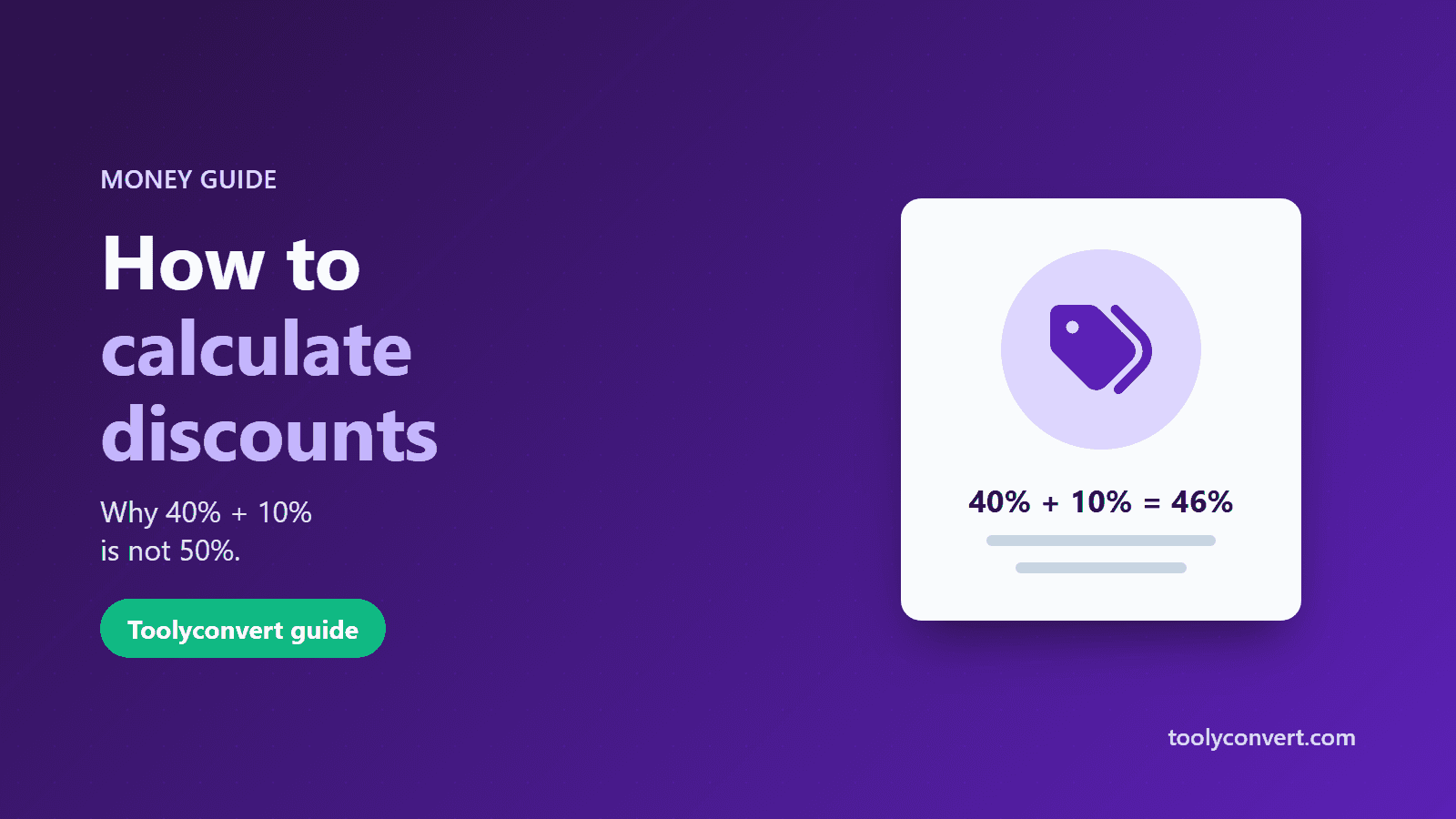
This is the one that surprises people. A shop offers 40% off, and a bank card gives an extra 10%. The total is not 50%, because the second discount is taken from the already reduced price:
2,499 × 0.60 = 1,499.40   (after 40% off)
1,499.40 × 0.90 = 1,349.46 (after 10% more)
Total saving ₹1,149.54, which is 46% of the original. In general, multiply the parts you pay: 0.60 × 0.90 = 0.54, so you pay 54% and save 46%.
| Offers | Real total discount |
|---|---|
| 20% + 10% | 28% |
| 30% + 20% | 44% |
| 40% + 10% | 46% |
| 50% + 50% | 75%, not 100% |
Amount off instead of percent off
A flat “₹500 off” is a bigger percentage on a cheaper item:
- ₹500 off ₹1,500 = 33.3% off
- ₹500 off ₹5,000 = 10% off
To compare a flat offer with a percentage offer, convert the flat amount to a percentage: amount ÷ price × 100.
Finding the original price
You see a sale price and a discount, but not the original price:
Original price = Sale price ÷ (1 − Discount ÷ 100)Example: £45 after 25% off → 45 ÷ 0.75 = £60. A common mistake is to add 25% back to £45, which gives £56.25 — wrong, because the 25% was taken from the bigger number.
Finding the real discount percentage
When a shop shows two prices but no percentage:
Discount % = (Original − Sale) ÷ Original × 100Example: ₹1,999 down to ₹1,599 → 400 ÷ 1,999 × 100 = 20%.
Tax and GST
In India, shop prices and MRP normally include GST, so a discount on the tag price is the final saving. Where tax is added at checkout (US sales tax, many B2B invoices), it is charged on the discounted price:
$80 at 25% off = $60, plus 8% sales tax = $64.80The order matters only for the tax amount, not for whether the discount applies. To add or remove GST from a price, use the GST Calculator; for more on the rates, see how to calculate GST.
“Buy X get Y free” offers
Divide the free items by the total you take home:
| Offer | Effective discount per item |
|---|---|
| Buy 1 get 1 free | 50% |
| Buy 2 get 1 free | 33.3% |
| Buy 3 get 1 free | 25% |
| Buy 1 get 1 at 50% off | 25% |
These only save money if you wanted the extra items.
Is it really a good deal?
- Check the “was” price. A large percentage off an inflated original price saves less than it looks. Compare with other shops.
- Look at the price per unit for groceries and bulk packs.
- Read coupon conditions: minimum order values and maximum discount caps (“10% off up to ₹150”) change the maths. 10% off ₹3,000 with a ₹150 cap is only 5%.
Quick start
Open the Discount Calculator, enter the price and the discount, add any extra discount and tax, and set the quantity. Switch to Original price or Discount % for the reverse questions. For other percentage problems, see how to calculate percentages.