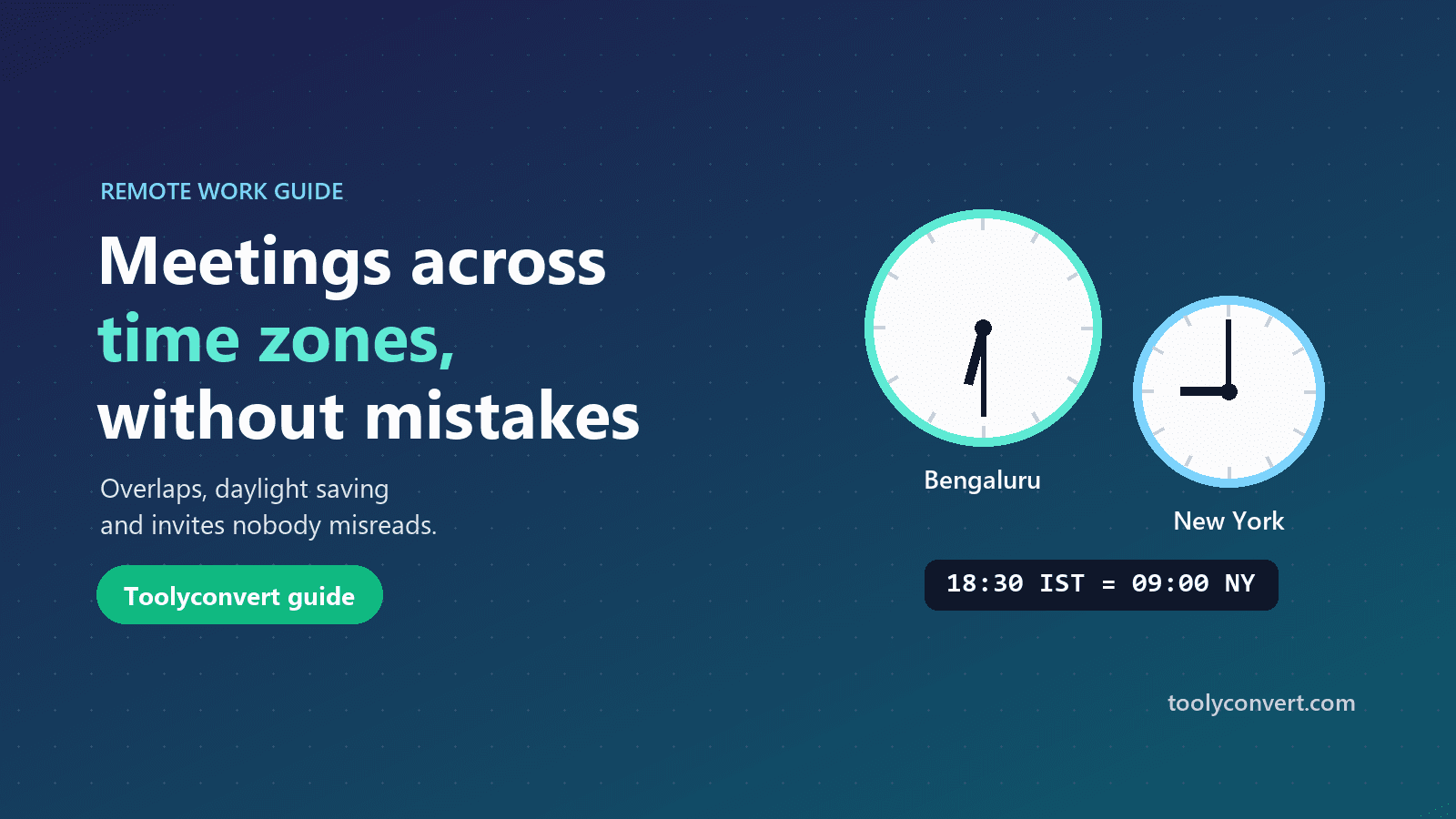
The invite said "Tuesday, 9:00 EST". The team in Bengaluru joined at 7:30 in the evening. The client in New York joined an hour later, because in July New York is on EDT, not EST, and the person who wrote the invite had converted with last winter's offset in their head. Nobody did anything unusual; time zones are simply easy to get wrong, and the cost is a missed meeting, a lost interview slot or a deadline that passes "yesterday" for half the team.
This guide shows how to find meeting times that work across India, Europe, the Middle East and the US, how daylight saving changes catch people out, and how to write invites nobody can misread.
The numbers that matter for India
India Standard Time (IST) is UTC+5:30 all year. India does not use daylight saving time, which makes it a stable anchor, but it means the gap to countries that do change their clocks moves twice a year.
| City | Difference from IST in their summer | Difference from IST in their winter |
|---|---|---|
| London | IST is 4 h 30 min ahead | IST is 5 h 30 min ahead |
| Berlin, Paris, Amsterdam | IST is 3 h 30 min ahead | IST is 4 h 30 min ahead |
| New York | IST is 9 h 30 min ahead | IST is 10 h 30 min ahead |
| San Francisco | IST is 12 h 30 min ahead | IST is 13 h 30 min ahead |
| Sydney | IST is 5 h 30 min behind | IST is 4 h 30 min behind |
| Dubai | IST is 1 h 30 min ahead (no daylight saving) | same |
| Singapore | IST is 2 h 30 min behind (no daylight saving) | same |
The half-hour offset is the source of many mistakes: people round it, or forget it when adding hours in their head. A converter that works from real time zone rules removes the guesswork. The Time Zone Converter uses your browser's time zone database, so it applies each country's daylight saving on the right dates automatically.
Daylight saving: the twice-a-year trap
Countries that use daylight saving do not all change on the same day:
- The US and Canada move clocks forward on the second Sunday in March and back on the first Sunday in November.
- The UK and the European Union move forward on the last Sunday in March and back on the last Sunday in October.
- Australia's south-eastern states, including Sydney and Melbourne, move forward in early October and back in early April, because their summer is in the northern winter.
That creates awkward weeks every spring and autumn. For about three weeks in March, and one week around the turn of October and November, the gap between London and New York is one hour less than usual. A recurring meeting set by someone in London will move for the people in New York, and vice versa. If you run regular calls across these regions, check the times again in March, late October and early November.
Find the overlap in working hours
The useful question is not "what time is it there?" but "when are we all awake and at work?". A practical method:
- List the cities, not the time zone abbreviations. Add each one to the Time Zone Converter; it remembers your list for next time.
- Pick a candidate time in your own zone and look at the labels. Each city is marked as working hours (9 am to 6 pm local), early, evening or night.
- Slide the time until everyone is in working hours, or as close as possible.
- Copy the times into the invite with the Copy times button.
Some combinations that work well for Indian teams:
- India and the UK or Europe: the early afternoon in India (around 1:30 to 4:30 pm IST) is morning in London and Berlin. This is the easiest overlap.
- India and the US East Coast: the realistic slot is the Indian evening and the American morning, for example 6:30 pm IST is 9 am in New York during American summer time, and 7:30 pm IST during American winter time.
- India and the US West Coast: there is no comfortable overlap. Someone has to take an early morning or late evening call. Rotate the inconvenient slot so the same people do not always carry it.
- India and Australia: Indian mornings overlap with Australian afternoons.
Watch the date, not only the time
When it is Monday evening in San Francisco, it is already Tuesday morning in India. Deadlines, release dates and "end of day" promises are where this bites. The converter shows "next day" or "previous day" beside any time that falls on a different date, so a Friday 5 pm Pacific deadline shows clearly as Saturday morning in India.
Two habits help:
- Write deadlines with a city: "Friday 6 pm London time" rather than "Friday EOD".
- For global teams, consider UTC for technical deadlines and logs, and local times for meetings.
Write invites nobody can misread
Most scheduling errors come from ambiguous wording rather than wrong arithmetic.
- Use city names, not abbreviations. "EST" is technically only correct in winter; in summer New York is on EDT. "IST" means India Standard Time to most Indians but Irish or Israel Standard Time to others. "9 am New York time" is unambiguous.
- Include the date with the time, especially across the date line.
- List each participant's local time. The Copy times button produces a short summary with every city's local time and date, one per line, that you can paste into the invite or chat.
- Let the calendar do the converting. Calendar apps store the meeting in a time zone and show each attendee their local time. Make sure your own calendar is set to the right zone before you create the event.
Remote jobs, interviews and travel
Time zones affect more than meetings.
Interviews. When a recruiter abroad proposes a slot, convert it immediately and reply with both times: "Thursday 10 am London, which is 3:30 pm for me in Pune." Confirming in both zones catches mistakes before the day.
Remote roles. A job "remote, US hours" can mean working from 7:30 pm to 3:30 am IST. Before accepting, check the overlap the team expects. When weighing offers, our guide on comparing two job offers covers how working hours and commute change an offer's real value, and the Offer Comparison tool puts the numbers side by side. If you are looking for remote work, the Remote Job Hunter shows each listing's location requirements.
Travel. Converting a landing time or a call home is quicker with your home city and destination saved in the converter. You can also open the map and click anywhere to see its local time, which helps when a place is not a well-known city.
Frequently asked questions
Why is the difference between India and the UK sometimes 4:30 and sometimes 5:30?
Because the UK uses daylight saving and India does not. In British summer time, the gap is 4 hours 30 minutes; in winter it is 5 hours 30 minutes.
Is EST the same as New York time?
Only in winter. In summer New York uses EDT, one hour ahead of EST. Writing "New York time" avoids the problem.
How do I find a meeting time for three or more countries?
Add all the cities, look at the working-hours labels, and move the time until everyone is in or near working hours. With India, Europe and the US East Coast, the Indian evening is usually the only shared slot.
Does the converter work offline?
Conversions use your browser's built-in time zone rules, so they work once the page has loaded. City search with Google and the map need a connection.
Time zones are not hard; ambiguity is. Name the city, include the date, check the overlap, and recheck around daylight saving changes. Keep your team's cities in the Time Zone Converter and copy the times straight into every invite.