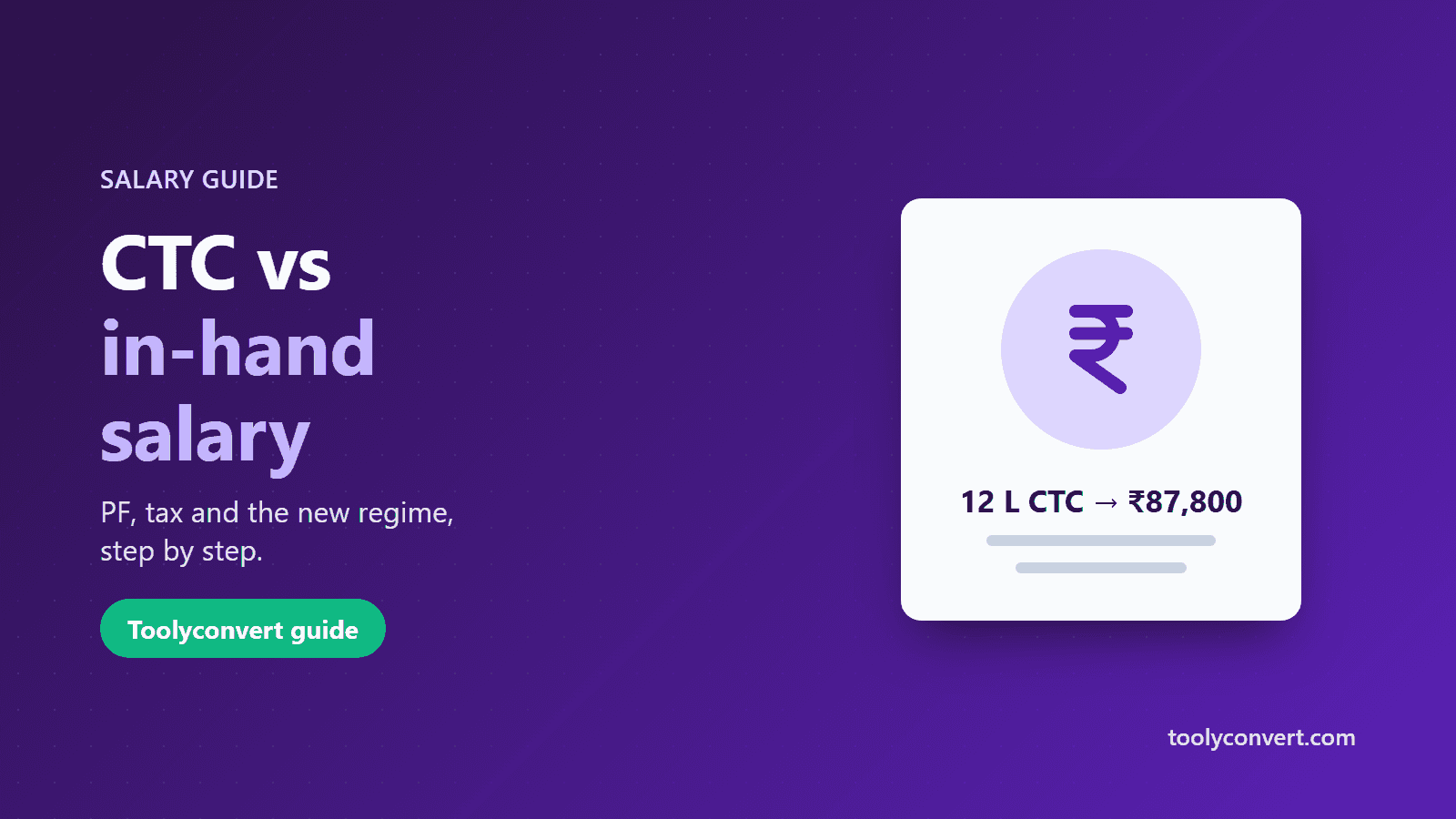
You accept an offer of ₹12 lakh CTC and expect ₹1 lakh a month. The first payslip says about ₹88,000. Nothing went wrong: CTC is what your job costs the company, not what you receive. This guide walks through the gap, step by step, using the income tax rules for FY 2026-27 (April 2026 to March 2027). To do it for your own offer, use the free In-Hand Salary Calculator.
CTC, gross and in-hand
- CTC (cost to company): everything the employer spends on you in a year, including their own PF contribution and sometimes gratuity and insurance.
- Gross salary: CTC minus the employer’s PF, gratuity and similar costs. This is the salary on your payslip before deductions.
- In-hand (net) salary: gross minus your own PF, professional tax and income tax. This reaches your bank account.
Step 1: Provident Fund
PF is calculated on your basic salary, usually 40–50% of CTC. You and your employer each contribute 12% of basic. Some employers cap PF at 12% of ₹15,000, which is ₹1,800 a month.
- The employer’s share is part of your CTC but is not paid to you monthly.
- Your share is deducted from your gross salary.
Both go into your PF account, so it is savings, not lost money.
Step 2: Gratuity (if included)
Some companies include gratuity in CTC at about 4.81% of basic. It is paid when you leave, usually after at least five years (one year for fixed-term staff), so it never appears in monthly pay.
Step 3: Professional tax
Most states charge professional tax of up to ₹2,500 a year, usually ₹200 a month. Some states, such as Delhi, charge none.
Step 4: Income tax under the new regime (FY 2026-27)
The new regime is the default. The slabs are the same as in FY 2025-26, but the Income-tax Act, 2025 applies from 1 April 2026, so the section numbers changed. For salaried people:
| Taxable income | Rate |
|---|---|
| Up to ₹4 lakh | Nil |
| ₹4–8 lakh | 5% |
| ₹8–12 lakh | 10% |
| ₹12–16 lakh | 15% |
| ₹16–20 lakh | 20% |
| ₹20–24 lakh | 25% |
| Above ₹24 lakh | 30% |
- A standard deduction of ₹75,000 is taken off your gross salary first.
- The Section 156 rebate (Section 87A until FY 2025-26) makes tax nil if taxable income is up to ₹12 lakh. Just above that, marginal relief limits the tax to the amount by which you cross ₹12 lakh.
- 4% health and education cess is added to the tax.
Worked example: ₹12 lakh CTC
Assume basic is 50% of CTC, PF is 12% of basic, no gratuity and ₹2,400 professional tax.
| Yearly | Monthly | |
|---|---|---|
| CTC | ₹12,00,000 | ₹1,00,000 |
| − Employer PF (12% of ₹6 lakh basic) | ₹72,000 | ₹6,000 |
| Gross salary | ₹11,28,000 | ₹94,000 |
| − Your PF | ₹72,000 | ₹6,000 |
| − Professional tax | ₹2,400 | ₹200 |
| − Income tax (taxable ₹10,53,000, within the rebate) | ₹0 | ₹0 |
| In-hand salary | ₹10,53,600 | ₹87,800 |
At ₹25 lakh CTC on the same assumptions, income tax is about ₹2.8 lakh a year and in-hand pay is about ₹1.6 lakh a month. The same working for other salaries: 5 LPA, 8 LPA, 10 LPA, 12 LPA, 15 LPA and 25 LPA.
New regime or old regime?
The old regime has higher tax rates but allows deductions such as 80C (now Section 123; up to ₹1.5 lakh, including your PF), 80D health insurance, HRA exemption and home-loan interest, with a ₹50,000 standard deduction. Since the 2025 changes, the new regime is better for most people. The old regime can still win if your deductions are large, so compare both before telling your employer which one to use.
Why your payslip may differ
Payslips can include meal cards, reimbursements, insurance premiums, variable pay paid quarterly, and tax spread unevenly across the year. Treat any calculation as an estimate and check your first payslip.
Quick checklist for an offer letter
- Find the basic salary and whether PF is capped.
- Check if gratuity and variable pay are inside the CTC.
- Use only the fixed part to estimate monthly pay.
- Compare both tax regimes.
Put your own numbers into the In-Hand Salary Calculator, and if you are planning a loan, see what EMI fits with the EMI Calculator.