Your result says SGPA 8.3 and CGPA 7.9, but how did the university get those numbers, and what do they mean as a percentage on a job form? This guide explains the method most Indian universities use, with a worked example. You can check your own numbers instantly with the free GPA, SGPA & CGPA Calculator.
Grade points on the 10-point scale
Under the UGC Choice Based Credit System (CBCS), followed by most universities, each letter grade has a grade point:
| Grade | Meaning | Grade point |
|---|---|---|
| O | Outstanding | 10 |
| A+ | Excellent | 9 |
| A | Very good | 8 |
| B+ | Good | 7 |
| B | Above average | 6 |
| C | Average | 5 |
| P | Pass | 4 |
| F | Fail | 0 |
Some universities use slightly different points, so if your grade card lists them, follow your grade card.
How SGPA is calculated
SGPA (Semester Grade Point Average) weights every subject by its credits:
- For each subject, multiply credits × grade point. This gives the credit points.
- Add up the credit points for all subjects.
- Divide by the total credits.
Worked example
| Subject | Credits | Grade | Credit points |
|---|---|---|---|
| Mathematics | 4 | A+ (9) | 36 |
| Physics | 4 | A (8) | 32 |
| Programming | 4 | O (10) | 40 |
| English | 2 | B+ (7) | 14 |
| Lab | 2 | A+ (9) | 18 |
| Total | 16 | 140 |
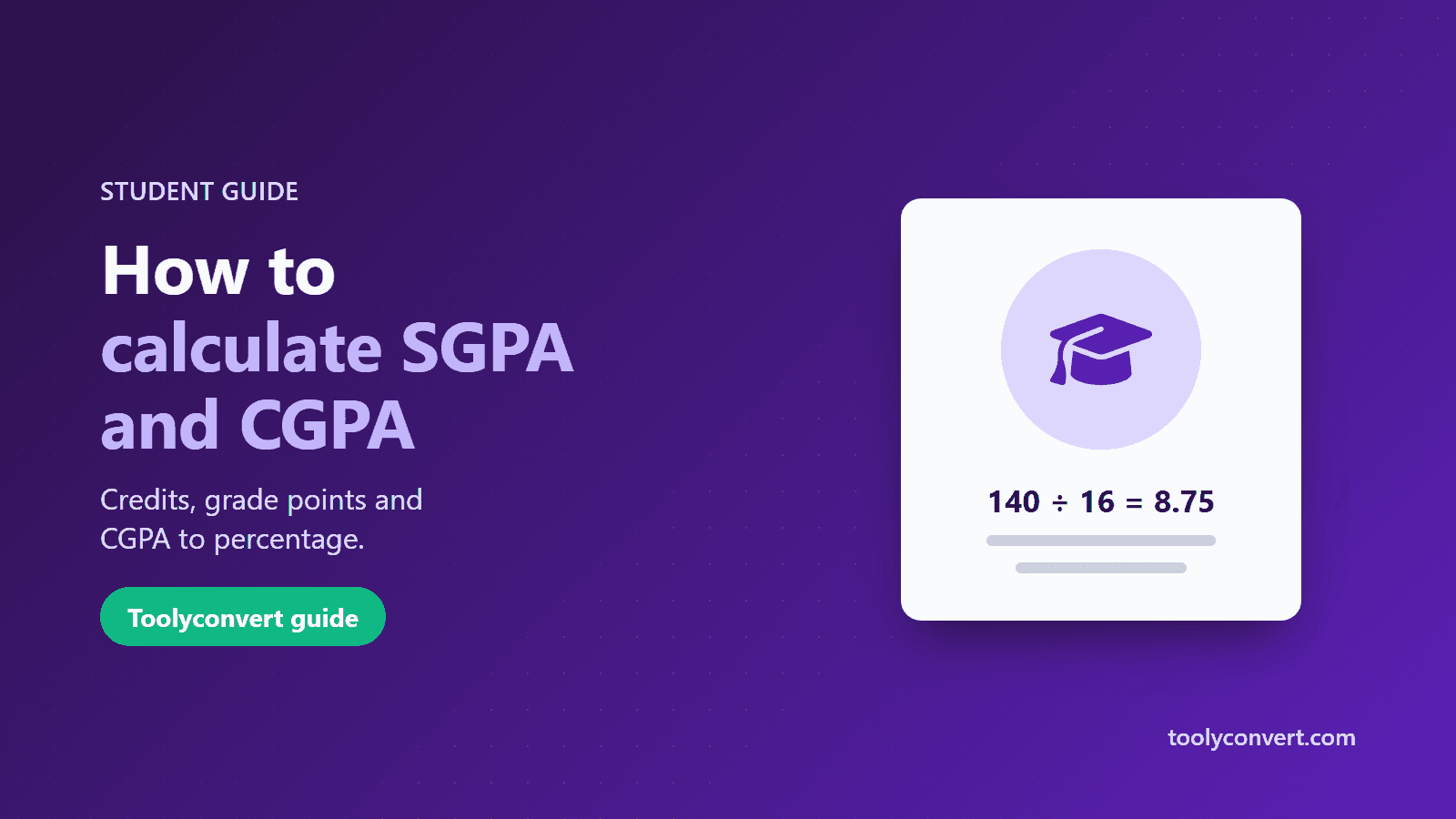
SGPA = 140 ÷ 16 = 8.75.
Notice that the 4-credit subjects move the result twice as much as the 2-credit ones. A low grade in a heavy subject hurts far more than one in a lab.
How CGPA is calculated
CGPA (Cumulative Grade Point Average) combines all the semesters you have completed. Most universities weight each semester by its credits:
CGPA = (SGPA₁ × credits₁ + SGPA₂ × credits₂ + …) ÷ total credits
For example, semester 1 with SGPA 8.2 and 22 credits, and semester 2 with SGPA 7.9 and 24 credits:
(8.2 × 22 + 7.9 × 24) ÷ 46 = (180.4 + 189.6) ÷ 46 = 8.04
A few universities simply average the SGPAs instead ((8.2 + 7.9) ÷ 2 = 8.05). Check your regulations; the calculator has an option for both.
How to convert CGPA to percentage
There is no single national formula.
- CBSE method: percentage = CGPA × 9.5. A CGPA of 8.2 is 77.9%.
- University formulas: many universities print their own, such as (CGPA − 0.75) × 10, on the marksheet or in the regulations. Employers and admissions offices expect that one.
- If nothing is given: some forms accept CGPA × 10. When in doubt, write the CGPA and state the formula you used.
In the calculator, choose × 9.5 or × 10, or type the multiplier your university uses.
What about a failed subject?
An F counts as 0 grade points with its full credits until you clear it. If Mathematics (4 credits) were an F in the example above, the SGPA would drop from 8.75 to 6.5. After you clear it, the new grade usually replaces the F in the calculation, depending on your university’s rules.
The 4.0 GPA scale
US universities use a 4.0 scale: A = 4.0, A− = 3.7, B+ = 3.3, B = 3.0, and so on down to F = 0. The weighted method is the same. Converting an Indian CGPA to a US GPA for admission is usually done by credential-evaluation services such as WES, so use their result for applications rather than a simple formula.
Quick checklist
- Use the credits from your syllabus, not just the grades.
- Weight CGPA by credits unless your regulations say otherwise.
- Use your university’s percentage formula where one exists.
- Keep a copy of your calculation for application forms.
Work out your own SGPA, CGPA and percentage with the GPA Calculator. To plan study time before exams, count the working days left with the Business Days Calculator.