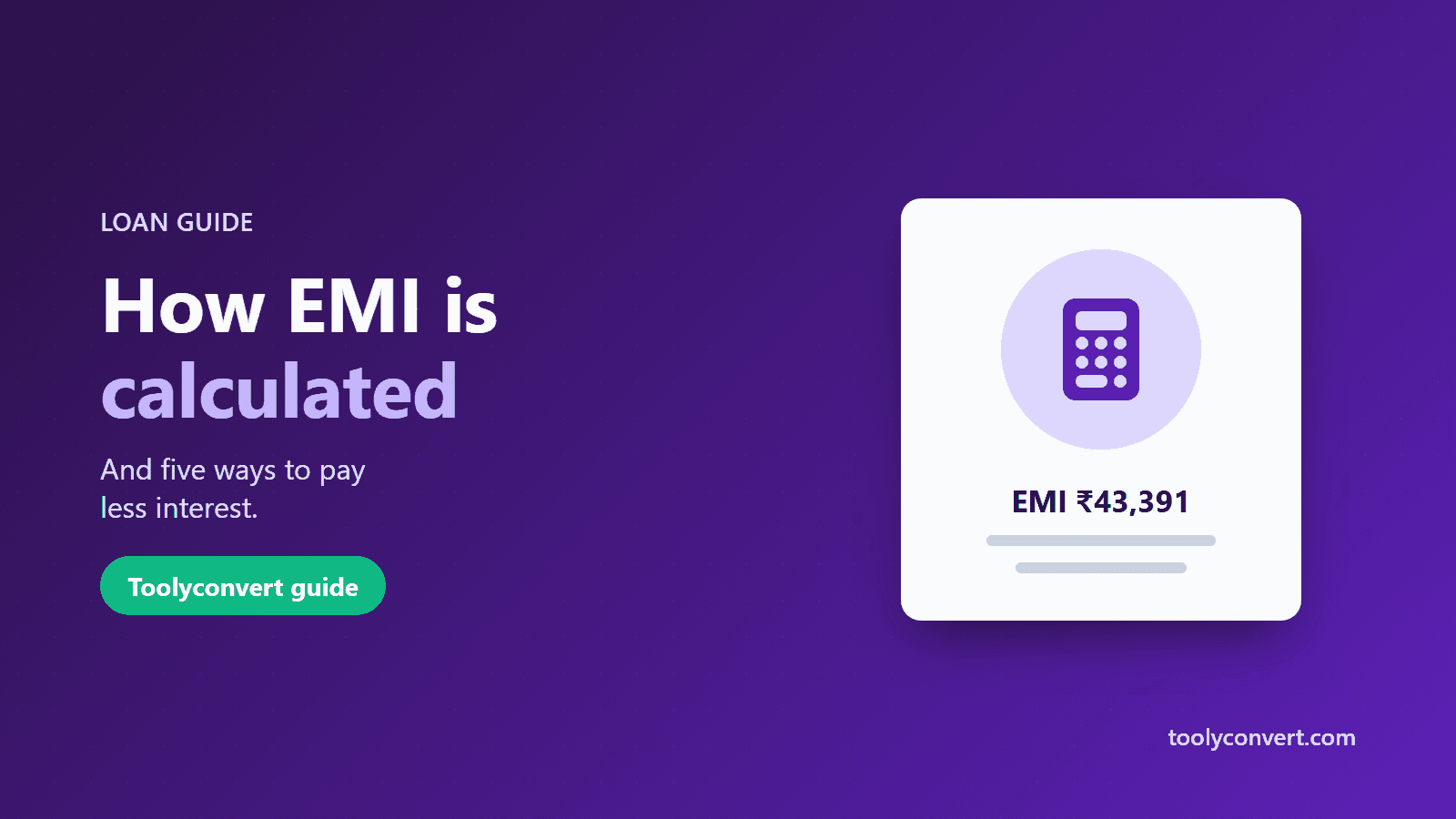
A home loan of ₹50 lakh at 8.5% for 20 years costs about ₹43,391 a month, and by the end you will have paid roughly ₹54 lakh in interest, more than the loan itself. Understanding how EMI works shows you where that interest comes from and how to cut it. Try every example here with the free EMI Calculator.
The EMI formula
Banks and NBFCs in India use the reducing-balance method:
EMI = P × r × (1 + r)ⁿ ÷ ((1 + r)ⁿ − 1)
- P = loan amount
- r = monthly interest rate = yearly rate ÷ 12 ÷ 100
- n = number of monthly instalments
Example
₹3 lakh personal loan at 12% for 3 years: P = 3,00,000, r = 0.01, n = 36.
EMI = 3,00,000 × 0.01 × 1.01³⁶ ÷ (1.01³⁶ − 1) ≈ ₹9,964.
Why early EMIs are mostly interest
Each month the bank charges interest on the outstanding balance, and the rest of the EMI repays principal. At the start the balance is highest, so most of the EMI is interest. In the ₹50 lakh example, the first EMI of ₹43,391 includes about ₹35,400 of interest and only about ₹8,000 of principal. Years later the split reverses.
That is why the yearly schedule in the calculator matters: it shows how slowly the balance falls in the first years of a long loan.
5 ways to pay less interest
1. Prepay early
Any extra payment reduces the balance on which interest is charged. With the EMI unchanged, the loan simply ends sooner. Adding ₹5,000 a month to the ₹50 lakh loan above saves over ₹13 lakh of interest and ends the loan about four years early. A lump sum such as a bonus works the same way; the earlier, the bigger the saving.
2. Choose the shortest tenure you can afford
A longer tenure lowers the EMI but raises total interest sharply. Compare 15 and 20 years in the calculator and pick the shortest one whose EMI stays comfortable.
3. Get a better rate
On a long loan, small rate differences are large in rupees. On ₹50 lakh for 20 years, 8.0% instead of 8.5% saves about ₹3.7 lakh. Check your credit score, compare lenders, and ask your bank about a lower rate or a balance transfer.
4. Increase your EMI when your salary grows
Raising the EMI by 5–10% each year shortens a 20-year loan dramatically. Many banks allow this on request.
5. Watch floating-rate changes
Home loans are usually floating. When rates rise, banks often extend the tenure rather than raise the EMI, which quietly adds interest. Check your loan statement after every rate change.
Before you prepay
- Charges: floating-rate home loans to individuals usually have no prepayment penalty; fixed-rate and personal loans may.
- Emergency fund: keep several months of expenses before prepaying.
- Tax: home-loan interest deductions apply only in the old tax regime, which affects whether prepaying or investing is better for you.
How much EMI can you afford?
A common guideline is to keep all EMIs below 40–50% of take-home pay. Work out your take-home first with the In-Hand Salary Calculator, then test loan amounts in the EMI Calculator and download the schedule for your records.
Common questions
Is a flat rate the same as a reducing rate? No. A flat rate charges interest on the original loan for the whole tenure, so a 10% flat rate costs far more than 10% on a reducing balance. Ask the lender for the reducing-balance rate before comparing offers.
Should I prepay or invest? If your loan rate is higher than the return you can safely expect after tax, prepaying usually wins. Keep an emergency fund first either way.
Does a part-prepayment change my EMI? Usually the bank keeps the EMI and shortens the tenure, which saves the most interest. You can ask to reduce the EMI instead if cash flow matters more.