"Percent" means "per hundred". 18% is 18 out of every 100, or 0.18. Almost every percentage question in daily life, from exam results to a "Flat 30% off" sale, is one of six simple calculations. This guide gives each formula with a worked example. To skip the arithmetic, the free Percentage Calculator does all six and shows the working.
1. What is X% of a number?
Formula: X ÷ 100 × number
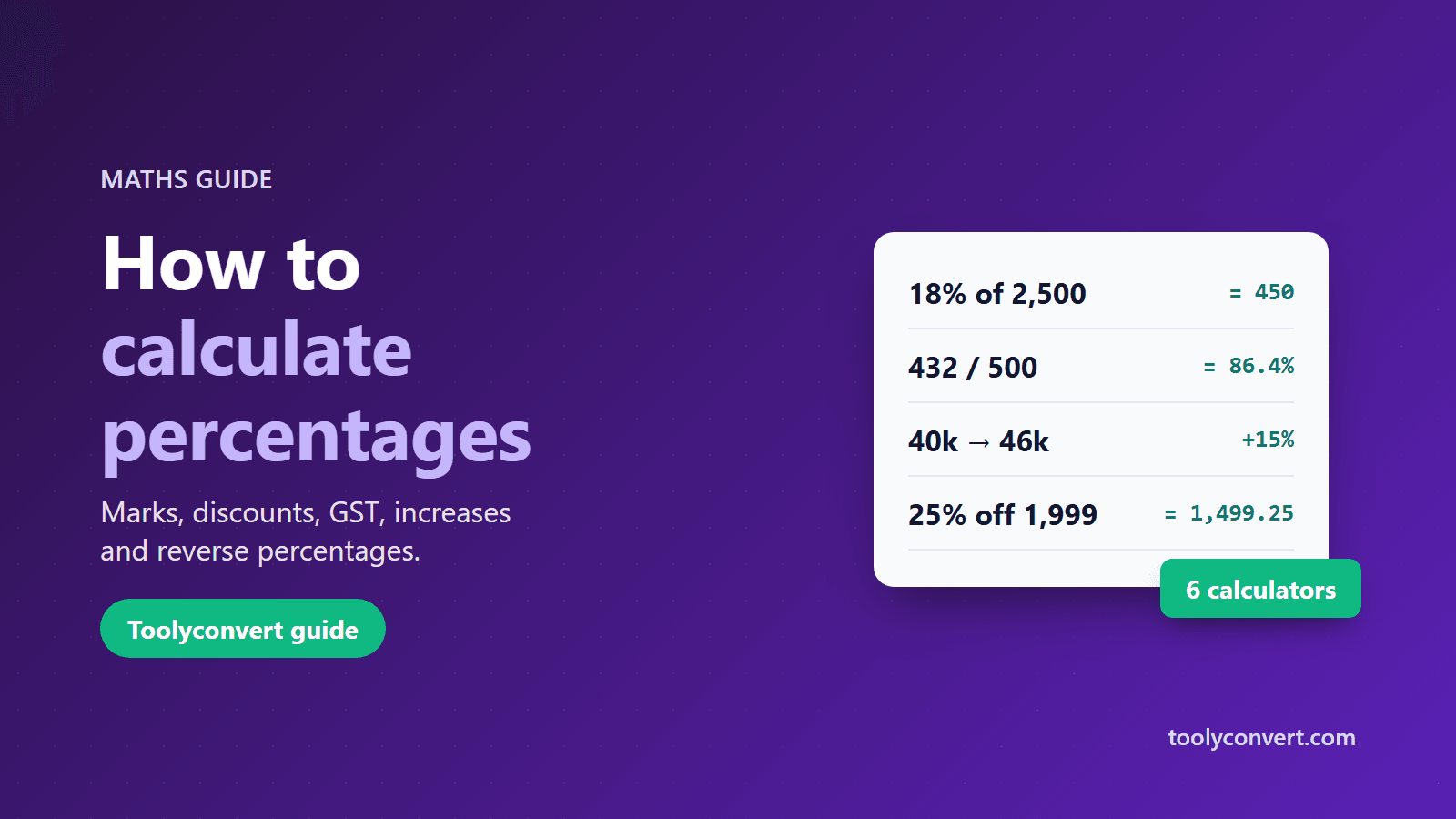
Example: 18% of ₹2,500 = 18 ÷ 100 × 2,500 = ₹450
Use it for: tips, commissions, the GST amount on a price, the share of a bill.
Mental shortcut: 10% is the number with the decimal point moved one place left (10% of 2,500 = 250). 5% is half of that (125), 20% is double (500). 18% = 10% + 5% + 3 × 1% = 250 + 125 + 75 = 450.
2. What percent is one number of another? (marks percentage)
Formula: part ÷ whole × 100
Example: You scored 432 out of 500. 432 ÷ 500 × 100 = 86.4%
This is the formula for marks percentage. With several subjects, add all the marks you scored and divide by the total maximum marks; do not average the subject percentages if the subjects have different maximum marks.
| Subject | Marks | Out of |
|---|---|---|
| English | 82 | 100 |
| Maths | 95 | 100 |
| Science | 88 | 100 |
| Social Science | 79 | 100 |
| Hindi | 88 | 100 |
| Total | 432 | 500 |
432 ÷ 500 × 100 = 86.4%.
3. Percentage increase or decrease
Formula: (new − old) ÷ old × 100
Example (increase): salary ₹40,000 → ₹46,000. (46,000 − 40,000) ÷ 40,000 × 100 = +15%
Example (decrease): price 80 → 60. (60 − 80) ÷ 80 × 100 = −25%
Always divide by the old value. Dividing by the new one is the most common mistake.
4. Add a percentage (GST, markup, hike)
Formula: number × (1 + X ÷ 100)
Example: ₹1,000 + 18% GST = 1,000 × 1.18 = ₹1,180
For GST bills with CGST and SGST, the GST Calculator splits the tax for you; our guide on how to calculate GST covers it in detail.
5. Take a percentage off (discounts)
Formula: number × (1 − X ÷ 100)
Example: 25% off ₹1,999 = 1,999 × 0.75 = ₹1,499.25
Two discounts do not add up. "40% + 10% extra off" on ₹1,000 is 1,000 × 0.60 × 0.90 = ₹540, which is a 46% discount, not 50%.
6. Find the original number (reverse percentage)
Formula: part ÷ (X ÷ 100)
Example: a ₹45 tip was 15% of the bill. 45 ÷ 0.15 = ₹300
Removing GST from an inclusive price is a reverse percentage too. If ₹1,180 includes 18% GST, the price before tax is 1,180 ÷ 1.18 = ₹1,000. Subtracting 18% (1,180 × 0.82 = ₹967.60) gives the wrong answer.
Three traps to avoid
Up and down are not symmetric. A 20% rise followed by a 20% fall does not get you back: 100 → 120 → 96. A share that falls 50% needs to rise 100% to recover.
Percent vs percentage points. If a loan rate goes from 8% to 10%, it rose by 2 percentage points, which is a 25% increase in the rate. News reports often mix these up.
Percentage of a percentage. "60% of students passed, and 30% of those got distinction" means 0.60 × 0.30 = 18% of all students got distinction.
CGPA to percentage
Universities use their own conversion. A common rule (used by CBSE for Class 10) multiplies CGPA by 9.5, but many universities use different formulas, so always check your university's official rule before you fill a form. The GPA Calculator can work out your GPA from subject grades.
Summary
| Question | Formula |
|---|---|
| X% of N | X ÷ 100 × N |
| A is what % of B | A ÷ B × 100 |
| % change from old to new | (new − old) ÷ old × 100 |
| N plus X% | N × (1 + X/100) |
| N minus X% | N × (1 − X/100) |
| A is X% of what | A ÷ (X/100) |
The Percentage Calculator has a mode for each row and shows the formula with your numbers, so you can check the answer or copy the working.