There is a quiet fear behind most complicated writing. If I use simple words, will people think I am not an expert? If my sentences are short, will it sound childish? So we reach for "utilise" instead of "use", stack three clauses into one sentence, and end up with text that impresses nobody and loses half its readers by the second paragraph.
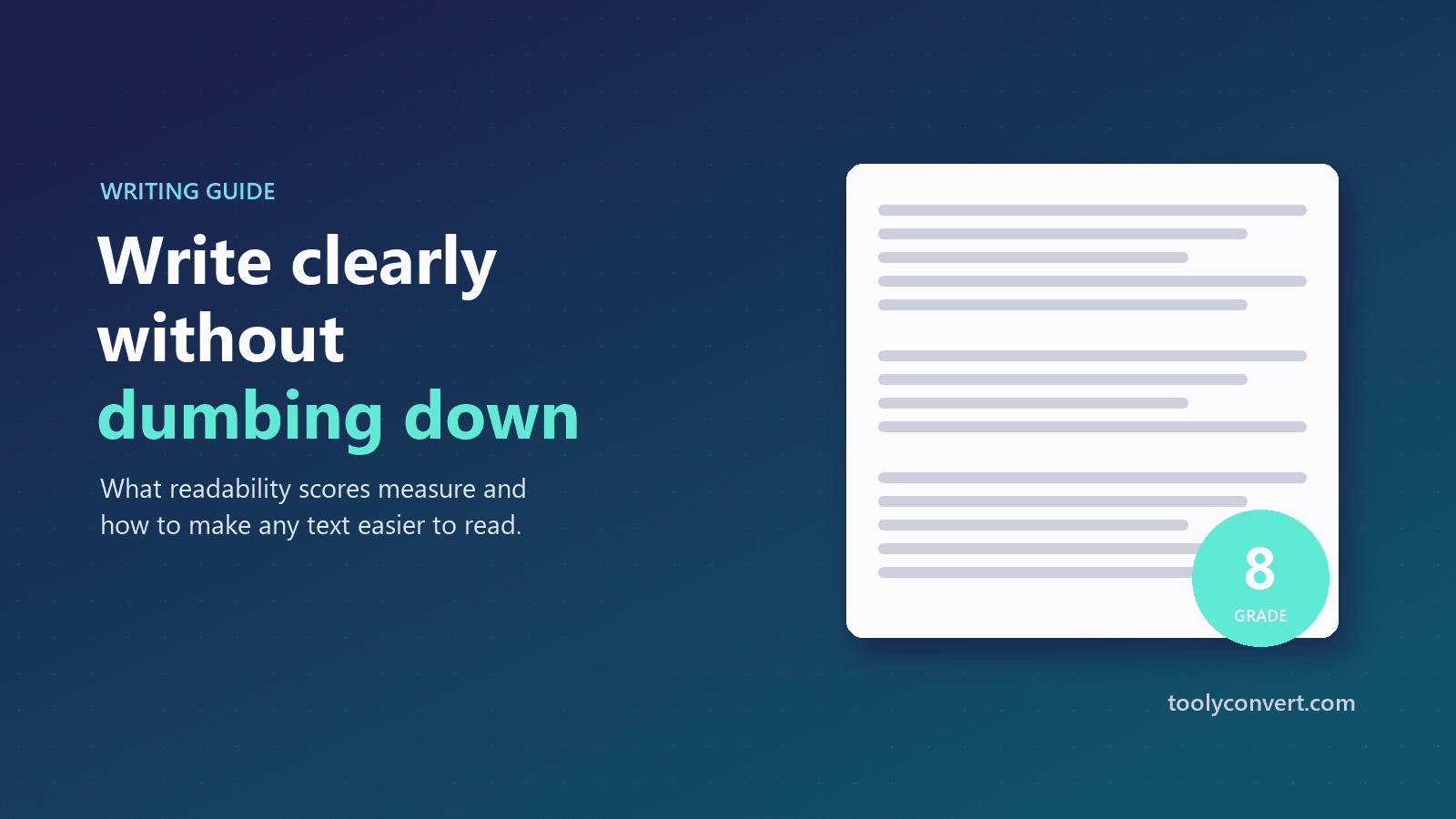
Here is the truth that good writers, editors and communicators know: clear writing is not dumbed-down writing. It is respectful writing. It respects the reader's time and attention, and it takes more skill, not less. This guide explains what readability scores measure, why an 8th grade level is such a common target, and practical techniques to make any text easier to read without losing its meaning or its voice.
Why clear writing wins
Most people do not read online text word by word. They scan, skim and decide within seconds whether to keep going. On a phone, a long, dense paragraph looks like a wall. Even highly educated readers prefer plain language when they are busy, tired or reading in their second language, which describes most people most of the time.
Clear writing also has practical benefits:
- More people understand it. That matters for instructions, health information, contracts and anything with consequences.
- People act on it. A clear call to action gets more clicks than a clever but confusing one.
- It builds trust. Readers trust writing they understand, and they are suspicious of text that seems to hide behind jargon.
- It helps accessibility. People with dyslexia, cognitive differences or limited literacy benefit enormously from plain language.
What readability scores actually measure
The Reading Level Checker uses two of the most widely used formulas. Both are built from the same two ingredients: how long your sentences are (words per sentence) and how long your words are (syllables per word).
Flesch Reading Ease
A score from 0 to 100, where higher means easier.
| Score | Difficulty | Roughly readable by |
|---|---|---|
| 90–100 | Very easy | 11-year-olds |
| 70–80 | Fairly easy | 12–13-year-olds |
| 60–70 | Plain English | 13–15-year-olds and most adults |
| 50–60 | Fairly difficult | Older teenagers |
| 30–50 | Difficult | University students |
| 0–30 | Very difficult | Graduates, specialists |
Flesch–Kincaid Grade Level
The same inputs converted into a US school grade. Grade 8 means a typical 13 to 14-year-old could follow the text. It does not mean your readers are 13; it means the text does not demand more effort than necessary.
Why grade 8 is the sweet spot
Many government style guides, health organisations and content teams aim for grade 6 to 8 for general audiences. Not because readers cannot handle more, but because text at this level is comfortable for almost everyone, including experts in a hurry. A specialist reading grade 8 text does not feel patronised; they feel relieved.
That said, the right level depends on your audience. Technical documentation for engineers, legal analysis and academic writing can reasonably score higher. The goal is not to hit a number at all costs, but to remove difficulty that does not serve the reader.
Seven techniques that lower the score without losing meaning
1. Split long sentences
The single biggest lever. If a sentence has more than 25 words, look for the natural break: an "and", a "which", or a second idea. Two sentences of 12 words are far easier than one of 24.
2. Prefer short, common words
Use "use" instead of "utilise", "help" instead of "facilitate", "start" instead of "commence", "about" instead of "approximately". Short words are not less precise; they are just less tiring.
3. Write in the active voice
"We sent your refund on Monday" is shorter and clearer than "Your refund was sent by us on Monday". Active sentences also make it clear who is doing what, which matters in instructions and policies.
4. Cut filler phrases
"In order to" becomes "to". "Due to the fact that" becomes "because". "At this point in time" becomes "now". These phrases add syllables and nothing else.
5. Put the main point first
Readers decide quickly whether to continue. Lead each paragraph with its key idea, then add detail.
6. Explain jargon once, or replace it
If a technical term is necessary, define it the first time in plain words. If it is not necessary, use the everyday word instead.
7. Use lists for steps and options
A list of four steps is easier to follow than a paragraph describing them, and it naturally shortens sentences.
A before and after
Here is a typical sentence from a policy page:
In the event that a customer wishes to initiate a return, it is necessary
for the customer to ensure that the item is returned in its original
packaging within a period of thirty days from the date of delivery.
And a clearer version:
Want to return something? Send it back in its original packaging within
30 days of delivery.
The meaning is identical. The second version is less than half the length, friendlier, and would score dramatically better on both formulas.
Using a readability checker well
Scores are a guide, not a judge. A few tips for getting real value from them:
- Check prose, not headings and lists. Lines without full stops can be counted as part of a longer sentence and skew the score. Paste paragraphs of normal text.
- Compare drafts. The formulas are most useful for seeing whether an edit made things clearer.
- Look at the counts. The checker shows total words and sentences; a high words-per-sentence average tells you exactly what to fix.
- Read it aloud. If you run out of breath, the sentence is too long, whatever the score says.
The formulas are designed for English, so other languages will not score meaningfully.
Where readability matters most
- Web pages and product descriptions, where visitors scan before deciding.
- Emails, especially ones that ask someone to do something.
- Help articles and instructions, where confusion leads to support tickets.
- Health, legal and financial information, where misunderstanding has real consequences.
- Resumes and cover letters. Recruiters skim quickly; clear, concrete sentences stand out. Our guide to writing an ATS-friendly resume shows how to write achievements that are both clear and specific, and the Resume Builder gives you a clean structure to put them in.
For longer pieces, it also helps to watch overall length. The Word Counter shows word, sentence and paragraph counts as you edit, which is handy when you are working to a limit.
Keeping your voice
A common worry is that simple writing sounds bland. It does not have to. Personality lives in word choice, rhythm, examples and honesty, not in long words. Short sentences can be warm. Plain language can be funny. Some of the most memorable writing in the world is simple.
Try this: take one paragraph you have written recently, paste it into the Reading Level Checker, and apply just two techniques from above, splitting the longest sentence and swapping three long words for short ones. Check the score again. More importantly, read both versions aloud. You will hear the difference, and so will your readers.